Indiana Dog Registration Information
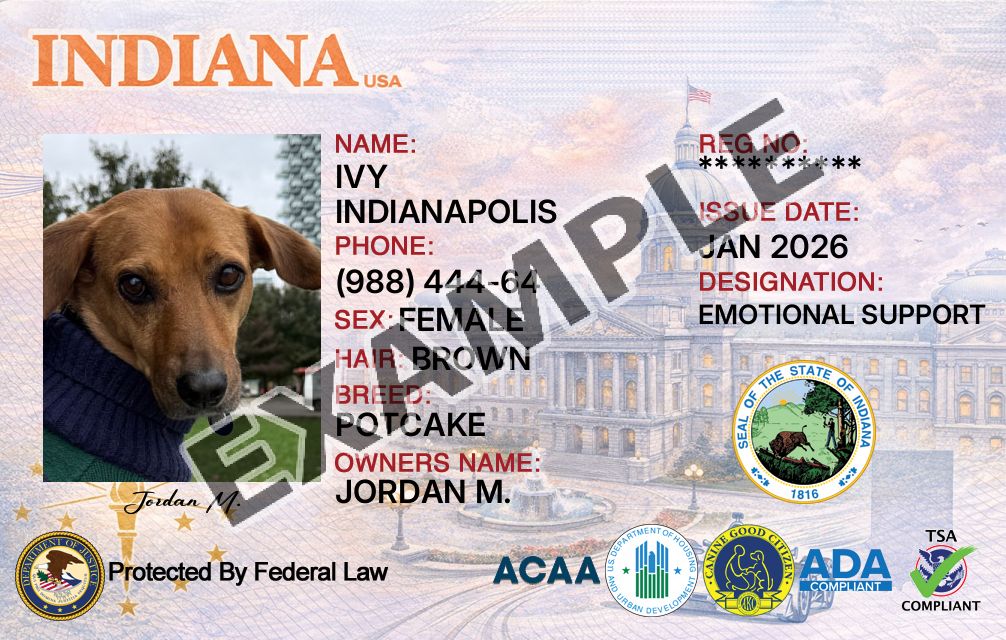
State Licensed, Service Dogs and Emotional Support Dogs in Indiana
If you’re searching where do I register my dog in Indiana for my service dog or emotional support dog, the most important thing to know is this: Indiana does not have a single statewide “service dog registration” or “emotional support dog registry” that makes a dog official. What most people mean by “register” is getting a dog license in Indiana (and staying compliant with rabies vaccination rules). In Indiana, dog licensing is typically handled locally—most often through a city animal control agency, a county animal control partner, or another local office that enforces animal ordinances and rabies rules.
This page explains where to register a dog in Indiana (by licensing locally), what documents you’ll usually need, and how licensing is different from a dog’s service dog legal status or an emotional support animal accommodation.
Where to Register or License Your Dog in Indiana
Because local rules vary, the best starting point is your city or county animal control or the local agency that issues pet licenses and enforces animal ordinances. Below are several example official offices in Indiana that handle dog licensing, animal control, and/or rabies-related enforcement in their jurisdictions. If you live outside these areas, look for your city’s animal control department or your county’s animal control page.
South Bend Animal Resource Center (SBARC)
- Address: 521 Eclipse Place, South Bend, IN 46628
- Phone: 574-233-0311
- Email: sbarc@southbendin.gov
- Office hours: Monday–Friday 9:00 am–5:00 pm (Closed the first Tuesday of every month)
Fort Wayne Animal Care & Control
- Address: 3020 Hillegas Road, Fort Wayne, IN 46808
- Phone: 260-427-1244
- Office hours: Business Office Hours (Lost & Found / Receiving / Citations): Monday–Friday 11:00 am–6:00 pm
City of Evansville Animal Care & Control Shelter
- Address: 815 Uhlhorn St, Evansville, IN 47710
- Phone: 812-435-6015
- Office hours: Monday–Friday 10:00 am–5:45 pm; Saturday 11:00 am–4:45 pm; Sunday Closed
Hamilton County Animal Control
- Address: 18100 Cumberland Road, Noblesville, IN 46060
- Phone: 317-773-1282 (Non-emergency)
- Note: Municipal contacts vary by city within Hamilton County.
Humane Society of St. Joseph County (Department of Animal Control) — Licensing
- Address: 2506 Grape Rd., Mishawaka, IN 46545
- Phone: 574-255-4726
- Email: info@humanesocietystjc.org
Tip: Some Indiana counties contract licensing and animal control services through a humane society or similar local partner. Always confirm which office issues the license tag for your address.
Overview of Dog Licensing in Indiana
Who actually “registers” dogs in Indiana?
In Indiana, there isn’t one statewide pet registry that everyone uses. Instead, a dog license in Indiana is usually issued under a local ordinance and administered by a local agency. Depending on where you live, that office might be:
- A city animal control department (common in larger cities)
- A county animal control division
- A county-contracted partner (for example, a humane society that handles animal control and licensing)
Why licensing exists (and why it’s often tied to rabies)
Local licensing programs help identify animals, reunite lost dogs with owners, and support local animal control operations. Many jurisdictions connect licensing to rabies compliance, because rabies is a public health issue and bite investigations often require proof of current vaccination.
Indiana rabies vaccination baseline (state rule)
Indiana’s rabies rules require that dogs (as well as cats and ferrets) 3 months of age and older be vaccinated against rabies, and vaccination must be maintained with ongoing revaccination (timing depends on the vaccine label and booster schedule). Indiana also does not allow rabies vaccination exemptions. Vaccine administration must be by (or under direct supervision of) a licensed and accredited veterinarian. These state rules apply statewide even though licensing is local.
How Dog Licensing Works Locally in Indiana
Step-by-step: where to register a dog in Indiana (the practical process)
- Find your issuing office: Start with your city’s animal control / animal resource center page. If you’re outside city limits, check your county animal control page or county government site to see who issues licenses. This is the fastest way to find animal control dog license Indiana information that matches your address.
- Confirm local requirements: Many offices require your dog to be current on rabies vaccination and may require proof of spay/neuter for discounted fees.
- Apply and pay: Some offices accept in-person applications; others allow mail or online processing. After approval, you typically receive a license tag.
- Attach tags and keep records: Keep a copy of your rabies certificate and license receipt (paper or digital). If your dog is ever picked up, a license tag can help speed reunification.
- Renew on time: Licenses are often annual, but renewal periods and late fees are local. Put a reminder on your calendar and align it with rabies booster timing.
What counts as “registration” for a service dog or emotional support dog?
In most Indiana communities, “registration” for any dog (pet, service dog, or ESA) means the same thing: a standard local pet license plus rabies compliance. If your dog is a service animal, you may see local references to a “service animal license” or “fee waiver,” but that does not replace the legal definition of a service dog under disability law.
Rabies tags vs. license tags (why you may have more than one tag)
Your veterinarian may provide a rabies vaccination tag, while your city/county may provide a separate license tag. Local ordinances may require dogs to wear certain tags; even when not explicitly required, it’s a strong identification tool if your dog is lost.
Service Dog Laws in Indiana
Service dog legal status is not created by “registration”
Under the ADA, a service animal is generally a dog trained to perform a task directly related to a person’s disability. Importantly, the ADA does not require service dogs to be professionally trained, certified, registered, or to wear a vest. Businesses and state/local governments generally must allow service dogs to accompany their handler in most places open to the public, even if they have a “no pets” policy.
What staff can ask (and what they can’t ask)
When it’s not obvious what service a dog provides, ADA guidance allows staff to ask only two questions: whether the dog is required because of a disability, and what work or task the dog has been trained to perform. Staff cannot require documentation that the dog is “registered” or “certified,” cannot require the dog to demonstrate the task, and cannot ask about the nature of the person’s disability.
What Indiana (and local governments) can still require
State and local governments can require service dogs to be licensed and vaccinated if all dogs are required to be licensed and vaccinated. In other words, your service dog may still need the same local license tag as any other dog in your county or city.
Emotional Support Animal Rules in Indiana
ESAs are different from service dogs
An emotional support animal (ESA) provides comfort or emotional support that helps alleviate symptoms of a disability, but—unlike a service dog—an ESA does not need to be trained to perform specific tasks. Under ADA public-access rules, emotional support animals are not service animals. That means an ESA generally does not have the same right to enter places like restaurants or stores that must allow service dogs.
Where ESAs matter most: housing accommodations
Under fair housing laws (and related Indiana civil rights guidance), a housing provider may be required to allow an assistance animal (including an emotional support animal) as a reasonable accommodation for a person with a disability, even when a property has a “no pets” rule. This is a housing process—not a license tag process—and it is separate from your local dog license in Indiana.
Frequently Asked Questions
Typically, no. Indiana does not operate a single statewide registry that makes a dog a service animal or ESA. What you usually must do is follow your local rules for a dog license in Indiana (issued by your city or county) and keep rabies vaccination current under Indiana rules. Service dog status comes from training for disability-related tasks (ADA definition), not from a certificate or online registry.
Start with your city government website (animal control / animal resource center). If you’re outside city limits, check your county animal control page or county government department listings. Because licensing is local, the answer to where to register a dog in Indiana depends on your address.
Not always. A veterinarian often issues a rabies vaccination tag after vaccination, while a local government office (or its contracted partner) may issue a separate license tag. Your local rules determine what must be displayed, but carrying both forms of identification can help if your dog is lost or involved in a bite investigation.
Under ADA guidance, staff generally cannot require documentation that your dog is registered, licensed, or certified as a service animal. They may ask only the two ADA questions when it’s not obvious: whether the dog is required because of a disability, and what work or task it has been trained to perform.
Call your city hall (if you’re in a city), your county government information line, or your local animal control office and ask: “Which office issues the animal control dog license Indiana tag for my address?” Some counties assign licensing to a contracted shelter or humane society, while others do it directly through a local government department.
Register A Dog In Other Indiana Counties
Select your county from the dropdown below to get started with your dog’s ID card. Requirements and license designs may vary by county, so choose your location to see the correct options and complete your pup’s registration.
- Adams County Dog Registration
- Allen County Dog Registration
- Bartholomew County Dog Registration
- Benton County Dog Registration
- Blackford County Dog Registration
- Boone County Dog Registration
- Brown County Dog Registration
- Carroll County Dog Registration
- Cass County Dog Registration
- Clark County Dog Registration
- Clay County Dog Registration
- Clinton County Dog Registration
- Crawford County Dog Registration
- Daviess County Dog Registration
- Dearborn County Dog Registration
- Decatur County Dog Registration
- DeKalb County Dog Registration
- Delaware County Dog Registration
- Dubois County Dog Registration
- Elkhart County Dog Registration
- Fayette County Dog Registration
- Floyd County Dog Registration
- Fountain County Dog Registration
- Franklin County Dog Registration
- Fulton County Dog Registration
- Gibson County Dog Registration
- Grant County Dog Registration
- Greene County Dog Registration
- Hamilton County Dog Registration
- Hancock County Dog Registration
- Harrison County Dog Registration
- Hendricks County Dog Registration
- Henry County Dog Registration
- Howard County Dog Registration
- Huntington County Dog Registration
- Jackson County Dog Registration
- Jasper County Dog Registration
- Jay County Dog Registration
- Jefferson County Dog Registration
- Jennings County Dog Registration
- Johnson County Dog Registration
- Knox County Dog Registration
- Kosciusko County Dog Registration
- LaGrange County Dog Registration
- Lake County Dog Registration
- LaPorte County Dog Registration
- Lawrence County Dog Registration
- Madison County Dog Registration
- Marion County Dog Registration
- Marshall County Dog Registration
- Martin County Dog Registration
- Miami County Dog Registration
- Monroe County Dog Registration
- Montgomery County Dog Registration
- Morgan County Dog Registration
- Newton County Dog Registration
- Noble County Dog Registration
- Ohio County Dog Registration
- Orange County Dog Registration
- Owen County Dog Registration
- Parke County Dog Registration
- Perry County Dog Registration
- Pike County Dog Registration
- Porter County Dog Registration
- Posey County Dog Registration
- Pulaski County Dog Registration
- Putnam County Dog Registration
- Randolph County Dog Registration
- Ripley County Dog Registration
- Rush County Dog Registration
- Scott County Dog Registration
- Shelby County Dog Registration
- Spencer County Dog Registration
- St. Joseph County Dog Registration
- Starke County Dog Registration
- Stueben County Dog Registration
- Sullivan County Dog Registration
- Switzerland County Dog Registration
- Tippecanoe County Dog Registration
- Tipton County Dog Registration
- Union County Dog Registration
- Vanderburgh County Dog Registration
- Vermillion County Dog Registration
- Vigo County Dog Registration
- Wabash County Dog Registration
- Warren County Dog Registration
- Warrick County Dog Registration
- Washington County Dog Registration
- Wayne County Dog Registration
- Wells County Dog Registration
- White County Dog Registration
- Whitley County Dog Registration